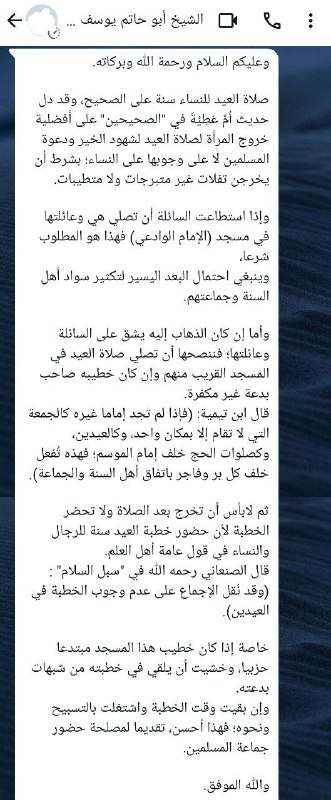
وعليكم السلام ورحمة الله وبركاته
If he preaches Tawheed and Sunnah, one has the option to remain or leave. But if he preaches Hizbiyyah, then one should not remain.
BENEFIT 474: Should You Remain to Listen to the ’Eid Khutbah If the Imam Is an Innovator?
Question:
السلام عليكم ورحمة الله وبركاته
الله يحفظكم
I wanted to ask, if my nearby masjid is a known spubs affiliated masjid, should I stay or leave for the khutbah after the ’Eid Salah? Whilst I do have the ability to travel to Masjid Muqbil instead, this masjid is alot closer for my family and I to attend
جزاكم الله خيرا
Sheikh Yūsuf Al-Jazaa’iri hafidahullāh:
وعليكم السلام ورحمة الله وبركاته
Eid prayer is…
BENEFIT 473: A Salafi Remains a Salafi — Even at Work!
Question: I am a brother who loves the Salafi da‘wah, and I am currently working in a supermarket in the Kingdom of Saudi Arabia. However, the store sells cigarettes. My employer recently asked me to work at the computer, although I have been working in the store for over four years as a regular worker. I stipulated to him that I would not directly sell cigarettes. If a customer requests cigarettes, I either call…
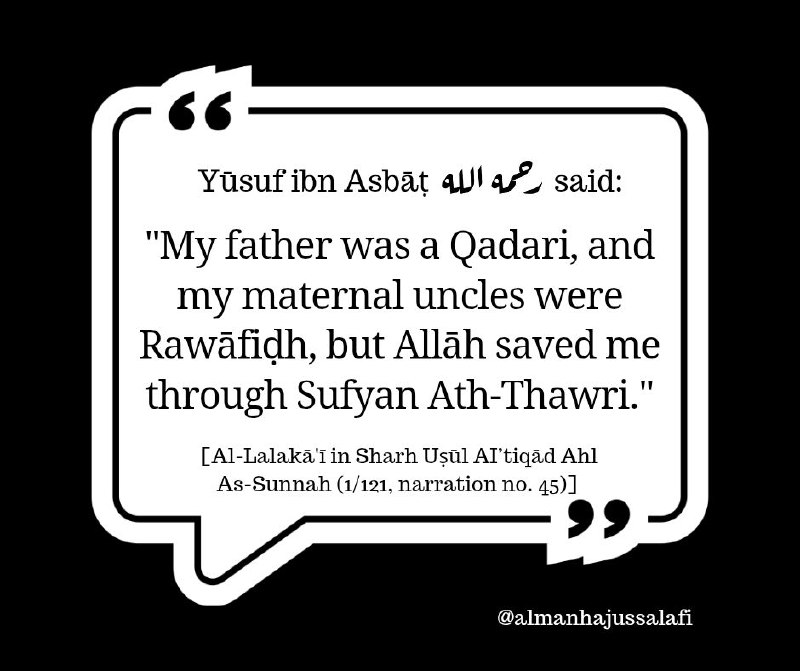
Among The Signs of Allāh’s Favour Upon a Student of Knowledge is Granting Him the Company of Ahlus-Sunnah
قال يوسف بن أسباط رحمه الله: «كان أبي قدريًّا، وأخوالي روافضَ، فأنقذني اللهُ بسفيان الثوري»
[أخرجه اللالكائي في الاعتقاد ١٢١/١ أثر ٤٥]
#Salafi_quotes #Beneficial_quotes
BENEFIT 472: A Sign of Foolishness: Rejecting an Opponent's Argument Before It's Heard
A benefit taken from Abu Atiyyah's lecture regarding Ṣulḥ Ḥudaybiyyah:
"...He (Budail) said: 'if you want I can relay this information to you.'
فَقَالَ «سُفَهَاؤهم لَا حَاجَة لَنَا أَن تُخْبِرَنَا عَنْهُ بِشِي»
The fools from among them said: "We don't need to hear anything that you have to say about him."
وَقَالَ ذَوُو الرَأِي مِنْهُمْ
And those who were wise among them said:
«هَاتِ مَا سَمْعت»
"Let us hear…
Where's so-and-so? We don't see them anymore?
Common response:
It's none of my business. I haven't been appointed to watch over them!
Advice of a scholar:
‎Sheikh Muḥammad ibn Ṣāliḥ Al-ʿUthaymīn raḥimahullāh said: “It is not from the brotherhood of īmān that when you see your brother falling short in the rights (of the religion) or you find him indulging in prohibited affairs you forsake him, making him a prey…
How can this be equated with someone who knew the falsehood, defended it knowingly, refuted those who opposed it, allied with its advocates, and attacked the people of truth with the most severe and r
Whoever attempts to judge both categories of people with the same standard is pursuing injustice. Is this not like someone trying to weigh camels and gold using the same scale?
In truth, those who are guilty of applying double standards are the adherents of the new Hizbi movement—such as Al-Buraʿī, Adh-Dhamārī, As-Sālimī, and Aṣ-Ṣawmalī, among others—for they judged Abul-Ḥasan, Al-Maghrāwī, and ʿArʿūr with a…
Doubt: If you declare Abul Hasan, Ali Al-Halabi, Muhammad Al-Imam and co. to be innovators, then it follows that you must also declare Shaykh Al-ʿAbbād and As-Suhaymī to be innovators as well.
Response:
In reply to this, I say: This doubt has already been addressed in my treatise 'At-Tandīd', where I stated:
"There are those who allege that Ahlus-Sunnah, in this fitnah, apply double standards—because they…
However, if Christians were to adopt the methodology of the Muslim Brotherhood, he would have had no objection to establishing such a division for them.
Look also at the words of Muḥammad ʿĀkif, the General Guide of the Muslim Brotherhood in Egypt, in an interview published by Al-Ṣaḥwah newspaper in Yemen (issue no. 918, dated 18-02-1425 AH). The interviewer asked:
“Would you accept Christians and non-religious individuals into the party?”
He replied:
«طالما أنَّهم سيَلتَزِمون بِفِكر ومناهِج وأهداف الحِزب فَلِمَ لا؟»
“As long as they adhere to the party’s…
Doubt: Salafīs often critique one another, which gives the impression of division, whereas their opponents appear more unified and better organised.
Response:
It should be said: If what this speaker means is that Ahlus-Sunnah do not remain silent regarding those who err—even if they are among their own ranks—and that they differ with such individuals when they abandon the truth and fall into falsehood, then this…
Doubt: “You are not obliged to accept my opinion, nor am I obliged to accept yours. Each person pursues what they believe brings them closer to Allāh the Exalted and Da’wah continues.”
Response:
This statement is precisely the same as the principle of “excusing and cooperating”—a foundational principle of the Ikhwānī manhaj:
"We cooperate in matters upon which we agree, and excuse one another in that which we…
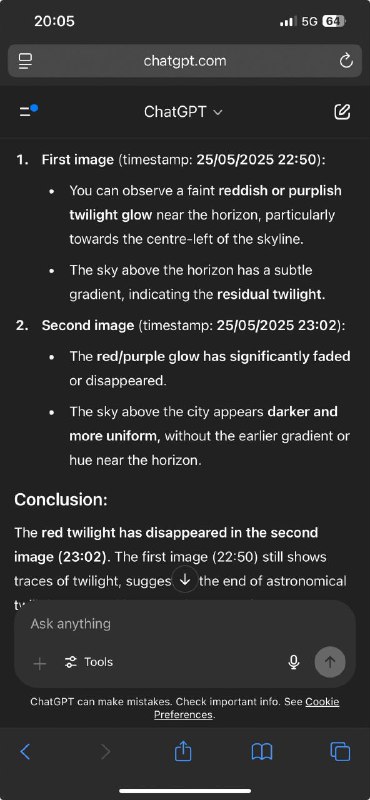
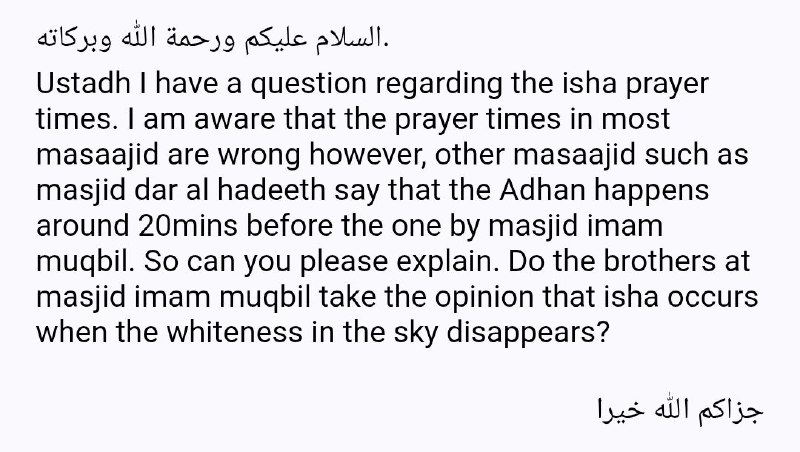
The fundamental ruling is that once the red twilight disappears, ‘Ishā prayer begins. However, it is more cautious to wait until the white light has also disappeared, and this is preferable because the recommended practice is to delay ‘Ishā until complete darkness. This is the preferable position. Although the basic principle is that when the red twilight vanishes, ‘Ishā time has entered, since this matter is…
The term shafaq in the Arabic language refers to both the red and the white twilights. Since this is the case, it is not permissible to limit the Prophet’s statement to one meaning without clear textu
2-> The white twilight may persist until midnight—yet midnight is the end time for ‘Isha. If shafaq referred to the white twilight, Maghrib would be excessively delayed, which is contrary to the evidences.
When Jibrīl taught the Prophet ﷺ the beginning and end times of the prayers, he performed Maghrib at the same time on both days, emphasising the short period for offering this prayer in comparison to other…
May Allāh reward you for your sincere efforts in seeking clarity on this issue. Since this question has been raised by several individuals, I took it as an opportunity to re-examine the matter and provide a balanced analysis and sound conclusion.
I ask Allāh for His assistance and guidance.
Your emails bring up several important questions, so I will address them accordingly in a question-and-answer…
BENEFIT 471: Profiting in the Name of Dawah | Abu Fajr AbdulFattaah ibn Uthman
Highlight:
Sheikh Al-Islām, may Allāh have mercy on him, said:
«وَجِمَاعُ هَذَا أَنَّ الْمُسْتَحَبَّ أَنْ يَأْخُذَ لِيَحُجَّ لَا أَنْ يَحُجَّ لِيَأْخُذَ وَهَذَا فِي جَمِيعِ الْأَرْزَاقِ الْمَأْخُوذَةِ عَلَى عَمَلٍ صَالِحٍ فَمَنْ ارْتَزَقَ لِيَتَعَلَّمَ أَوْ لِيُعَلِّمَ أَوْ لِيُجَاهِدَ فَحَسَنٌ...وأما من اشتغل بصورة العمل الصالح لأن يرتزق: فهذا من أعمال الدنيا، ففرق بين من يكون الدين مقصوده والدنيا وسيلة، ومن تكون…
After returning from Yemen, I began offering free classes to the community at Masjid Ummul Qura. However, when I observed the owner redirecting the da'wah in a direction I couldn't support, I decided to step away. Unfortunately, the masjid has since experienced a decline, hosting questionable speakers and engaging in concerning activities. I felt it important to clarify my stance in case anyone still believes I’m…
Painting over manhaj flaws may create an illusion, but the structural problems will remain—and grow.
Manhaj flaws are repaired through:
Repentance, rectification and clarification, as Allāh said:
﴿إِلَّا ٱلَّذِینَ تَابُوا۟ وَأَصۡلَحُوا۟ وَبَیَّنُوا۟ فَأُو۟لَـٰۤئكَ أَتُوبُ عَلَیۡهِمۡ وَأَنَا ٱلتَّوَّابُ ٱلرَّحِیمُ﴾
"Except for those who repent and correct themselves and make evident [what they concealed]. Those - I…
BENEFIT 469: Responding to Evil: The Obligation of the Student of Knowledge
Shaykh Ibn Bāz (may Allāh have mercy on him) said: "Then the student of knowledge must be extremely keen not to conceal anything of what he has learned."
Sheikh Yusuf Al-Jazaa'iri comments: This is a precious statement, and we shall now reflect upon it. It is a valuable piece of advice from Imām Ibn Bāz (may Allāh have mercy on him) to the student of knowledge.
Sheikh ibn Baz: "He is keen to clarify the truth and…
Ibn Al-Jawzi (may Allāh have mercy on him) said:
«فمطلق الهوى يدعو إلى اللذة الحاضرة من غير فكر في عاقبة، ويحث على نيل الشهوات عاجلا وإن كانت سببا للألم والأذى في العاجل ومنع لذات الآجل، فأما العاقل فإنه ينهى نفسه عن لذة تعقب ألما، وشهوة تورث ندما وكفى بهذا القدر مدحا للعقل وذما للهوى، وقد روي عن ابن عباس رضي الله عنهما أنه قال: ما ذكر الله عز وجل الهوى في موضع من كتابه إلا ذمه، وقال الشعبي: إنما سمي هوى لأنه يهوي…
Sheikh Al-Islam Ibn Taymiyyah (may Allāh have mercy on him) said:
«وصاحب الهوى يعميه الهوى ويصمه، فلا يستحضر ما لله ورسوله في الأمر ولا يطلبه، ولا يرضى لرضا الله ورسوله، ولا يغضب لغضب الله ورسوله، بل يرضى إذا حصل ما يرضاه بهواه، ويغضب إذا حصل ما يغضب له بهواه، ويكون مع ذلك معه شبهة دين أن الذي يرضى له ويغضب له أنه هو السنة، وهو الحق، وهو الدين، فإذا قدر أن الذي معه هو الحق المحض دين الإسلام، ولم يكن قصده أن يكون…
Etiquettes of Attending Gatherings of Knowledge | AbuFajr AbdulFattaah hafidahullah
Timestamps:
0:00 - Virtues of the gatherings of knowledge
7:10 - Etiquette #1: Sitting close together as if you're in a circle
11:33 - Etiquette #2: Sitting where the gathering ends
13:59 - Etiquette #3: Getting close to the speaker
17:04 - Etiquette #4: Making space in the gathering for each other
18:50 - Etiquette #5: Do not…